Performance
Timings for the two operations that dominate a run: growing a species tree, and evolving genomes along it.
What was measured
Every benchmark uses one regime: a birth–death species tree (λ = 1.0, μ = 0.3) grown to N extant tips, then genomes under D = 0.2, T = 0.1, L = 0.25, O = 0.5 from 20 initial families.
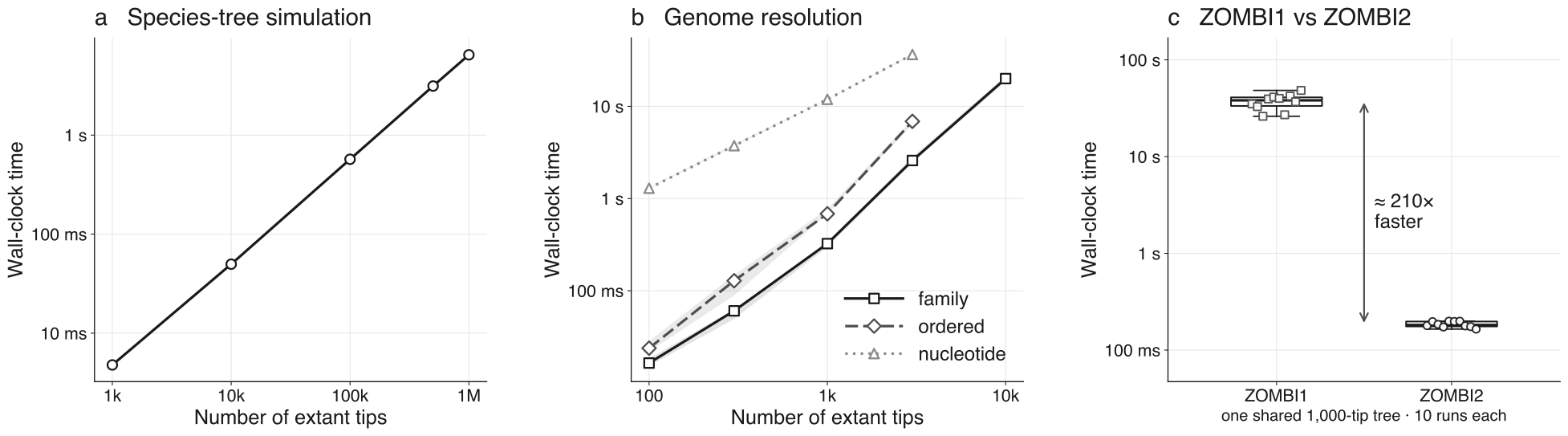
(a) Species trees. Linear in the number of tips: 0.57 s at 100,000 tips, 6.5 s at 1,000,000 (peak memory 2.3 GB).
(b) Genomes, at the three resolutions. family takes 0.32 s at 1,000 tips and 20 s at 10,000.
ordered — the same rates plus inversion = 0.1 — takes 0.68 s at 1,000 tips and 6.9 s at 3,000.
nucleotide, run on an M. tuberculosis H37Rv genome (4.41 Mbp), takes 12 s at 1,000 tips and 37 s
at 3,000. The three share rate values, not event counts: family and ordered rates are per gene
copy, nucleotide rates are per lineage. The panel therefore compares cost at matched rates, not at
matched work.
Family and ordered are super-linear in tip count. A tree grown to N extant tips deepens as ln N, so genome work grows faster than N.
(c) ZOMBI2 against the legacy ZOMBI1. One shared 1,000-tip species tree, both engines running their genome step on it, 10 runs each. The ZOMBI2 median is 0.18 s against ZOMBI1's 38.2 s — 210× faster. Both are pure Python, so this measures the rewrite, not a change of language.
Provenance
Measured on 2026-08-16, on ZOMBI2 main at commit fcfe57f, with CPython 3.12.2 and NumPy 1.26.4, on
macOS / Apple Silicon (10 cores). Each point is the median of five timed repeats — fewer at the
largest sizes — with the cyclic garbage collector disabled inside each timed call. Memory is peak
resident set size from an isolated subprocess, one measurement per size. Absolute times are
machine-specific; the scaling is not. The raw records — per-repeat times and an embedded provenance
header, one JSON per benchmark — are in the repository's
assets/performance/.