Genomes I: gene families
Genomes live inside the species tree, and they can be simulated at three resolutions, one per chapter: family here, ordered in Chapter 4, nucleotide in Chapter 5. The simplest is a gene family evolving along the tree; the most detailed tracks every nucleotide across several chromosomes.
The family resolution is genomes made of gene families and nothing more: no position along a chromosome, no DNA sequence. Genes can originate anywhere in the tree, and then they evolve by duplication, transfers and losses.
The four events
A genome at the family resolution evolves by four kinds of event, applied to every lineage as it runs down the species tree:
- Duplication. A gene copy is copied, so its family gains a member in that lineage.
- Transfer. A copy jumps from one lineage to another that is alive at the same moment.
- Loss. A gene copy is deleted; a family that loses its last copy is gone from that lineage.
- Origination. A brand-new family appears in a lineage, with one copy.
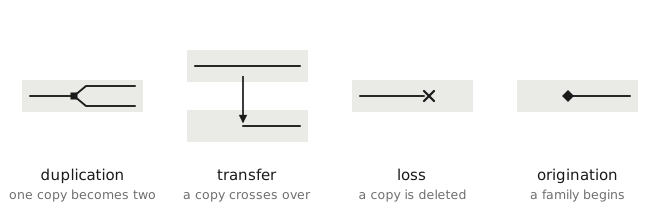
The initial genome, at the beginning of the stem, starts with initial_families families of one copy each (100 gene families by default); from there the four rates determine how they evolve.
Four things to know
- Families can evolve at different rates. This can be used to simulate for example genomes with a core and an accessory part (Ge4). Appendix A gives the spelling.
- A family's copies within one genome are capped, at
max_family_size=10by default, because a duplication rate above the loss rate can grow exponentially. - There is no minimum number of genes. Loss is counted per copy and the last copy is a copy like any other, so a high loss rate can leave a lineage with nothing.
genome_summary.jsonreportsempty_genomesand the command warns, because an empty genome is otherwise invisible.[^chromosome-minimum] - ZOMBI2 produces both complete and extant trees for the gene trees too. The complete tree keeps every gene lineage; the extant tree keeps only the copies that survive to the present. Both are described below.
[^chromosome-minimum]: The chromosome-based resolutions do keep a minimum: one gene per chromosome. A loss never takes a chromosome below its last gene, because a chromosome with nothing on it is not a chromosome. The minimum is per chromosome, not a bound on the genome's size: a whole chromosome, genes and all, still dies by chromosome_loss (Chapter 4).
What the rate depends on
By default, duplication, transfer and loss are counted per copy: a family with ten copies is ten times as likely to duplicate or lose one as a family with a single copy, which is usually what you want: more genes, more chances. Origination is counted per lineage (per branch of the species tree): acquiring a wholly new family is a property of the lineage, not of any gene it already has.
The three events (D, T, L) can also be expressed as PerLineage, but that implies a different model of evolution. For example, PerCopy(0.25) means that every copy can undergo an event independently, so a big genome loses often; PerLineage(0.25) is different: the lineage loses at that rate whatever it holds, so deletion-biased genomes lose at their own pace and shrinking does not slow them down. In a genome of a hundred genes the same 0.25 is a total loss rate of 25 one way and of 0.25 the other, a hundredfold apart.
A rate can also depend on time, on the clade where the gene is, or on a different level. Using changing_at on a rate makes it change at set moments: the skyline genome, fast early and slow later; Clade multiplies a rate inside a named subtree of the species tree, and the two compose (Ge5); and scaled_by makes a rate depend on a driver, which is Chapter 8. See Appendix A for more details.[^origins]
[^origins]: families=[family("toxin", origin=("n1", 0.4))] declares a family and places it instead of leaving it to the rate: it originates on the lineage you name, at the time you give, keeps its name, and adds to whatever initial_families and origination produce. With both of those at zero the tree carries exactly the families you declared.
Lateral gene transfers
When a transfer event occurs, the copy that triggers the events is one of that family's live copies, anywhere on the tree, and it is copied to another lineage that is alive at that same instant.
Three arguments are important for transfers:
transfer_to, who receives the copy."uniform"(the default) picks any other contemporaneous lineage with equal chance;"distance"makes closer relatives likelier: a recipient at distance d from the donor gets weight exp(−decay · d / depth), the depth being the tree's mean root-to-tip time, so the samedecaymeans the same thing on trees of different timescales."distance"isDistance(decay=1.0), andDistance(decay=)sets its own. A third rule,Clades(...), weights recipients by named clades of the tree, described below.replacement, what happens on arrival. By default the incoming copy is additive: the recipient simply gains a copy. Withreplacement=Trueit overwrites a copy of the same family already present, picked at random when the recipient holds several, and falls back to additive when it has none.self_transfer, whether a lineage may donate to itself. Off by default. With additive arrival the lineage gains a copy, so the gene content changes as it would under a duplication, but the event is recorded as a transfer. Underreplacementthe arrival never overwrites its own continuation: it displaces one of the lineage's other copies, or falls back to additive when there is none.
Transfers can arrive from a lineage that later goes extinct (Szöllősi et al. 2013). A genome run happens on the complete tree, dead branches included, so a gene can enter a survivor from a donor that leaves no other trace. That is the feature the software was originally named for: transfers from the dead, from zombie lineages.
Transfer between named clades
"distance" biases transfer by relatedness, but sometimes you want to name the groups yourself: "let genes flow between these two clades, and nowhere else." Clades does that. You name each clade, by a few of its tips (the clade is the subtree below their MRCA) or by the id of its root node. Either way a lineage is written as the n<id> label the tree files use, read off species_complete.nwk or species_events.tsv, so the example below names each clade by two of its tips. The weights go in a Between kernel, a table with one weight for each ordered (donor clade, recipient clade) pair (Ge3).
from zombi2 import species, genomes

sp = species.simulate_species_tree(birth=1.0, death=0.3, n_extant=16, seed=1)
# genes flow only BETWEEN clade A and clade B, never within either, never to the rest
flows = genomes.Between({("A", "B"): 1.0, ("B", "A"): 1.0}, default=0.0)
g = genomes.simulate_genomes_family(
    sp, transfer=1.0, initial_families=20, seed=2,
    transfer_to=genomes.Clades({"A": ["n27", "n28"], "B": ["n21", "n26"]}, flows))
There is one group you do not have to name: "rest" is every lineage outside the clades you did name, so Between({("rest", "A"): 8.0}) makes clade A a transfer hotspot that the whole rest of the tree donates into, without having to enumerate the rest of the tree.
Each entry is a weight, read the same way "distance"'s weights are: normalised over the lineages alive at the instant a transfer occurs. The weight belongs to each candidate lineage, not to the clade as a whole, so at the same weight a clade of twenty lineages receives ten times the flow of a clade of two. Naming only ("A", "B") and ("B", "A") and setting default=0.0 means every other pairing weighs 0: a clade-A donor can reach clade B but not another clade-A lineage, and the rest of the tree neither sends nor receives. Drop the default=0.0 and unlisted pairs return to weight 1 (baseline), so Between({("A", "B"): 5.0}) enriches A→B fivefold while leaving everything else to happen normally. A weight of 0 means "cannot receive", exactly as in Chapter 8: when a donor's every candidate weighs 0, the transfer has nowhere to land and does not happen.
Profiles and gene trees
A run returns two views of the same history, and the pair is worth keeping straight: the genomes at the extant tips are the observed dataset, and the genomes at every node, extinct and internal alike, are the run's own record of what happened. Appendix B names them and everything else.
Profiles are the classic comparative-genomics view (Pellegrini et al. 1999): how many copies of each gene family sit in each extant species.
g.profiles.matrix        # families × extant-species copy counts, a NumPy array
g.profiles.presence      # the same as 0/1 presence/absence
g.profiles.to_tsv()      # the table as text
Gene trees. Every family has a .complete tree with every gene lineage, and, when at least one copy survives, an .extant tree pruned to the genes that do. A family that died out has no extant tree: .extant is None, to_newick("extant") returns None, and the run writes no _extant file for it.
gt = g.gene_trees[7]                 # the gene tree of family 7
gt.to_newick("extant")               # the surviving copies as Newick ...
gt.to_newick("complete")             # ... or the whole genealogy
gt.origination                       # when the family began
The root of a gene tree carries a branch length, as the species tree's does. A family starts at its origination, and the founding gene lives a while before its first duplication, transfer or speciation; that wait is the root's branch, the family's stem. A gene that originated and never split at all is a one-node tree, written as its own lifespan, n26_g545:0.6614353;.
Evolving families in parallel
Because families are independent, a run can evolve them concurrently, one family per worker process. It is off by default; parallel turns it on.
parallel=True uses every core and an integer sets the worker count; on the command line it is --parallel for all cores or --parallel 8 for eight. It is a separate engine, not a faster path through the default one: each family draws from its own random stream, so the result is identical for any worker count, but it differs from a serial run of the same seed. Both are valid draws of the same process.
For very large runs of hundreds of thousands of families, or a million, the difficulty stops being speed and becomes memory. stream_to writes each family to a directory the moment it is done, and returns a light handle holding a path rather than the ordinary result object (a FamilyGenomesResult) holding everything. Memory then stays flat however many families you run, so a run that would have held 2 GB in memory streams in about 40 MB, and the sequence level reads the families back off the disk afterwards. On the command line this is --stream.
tree = species.simulate_species_tree(birth=1.0, death=0.3, n_extant=20, seed=1)
run = genomes.simulate_genomes_family(
    tree, origination=2.0, initial_families=5000, seed=1,
    parallel=8, stream_to="out/", outputs=("events", "profiles", "species_tree"))
run.path("events")            # out/genome_events.tsv — the log the sequence level replays
On the command line
zombi2 genomes evolves gene families along the species tree already in the run directory, or one given with --from (a Newick file, or another run). The family resolution is the default, and a rate is a plain number or a quoted expression in the written form of Appendix A.
# duplication–loss–origination along a species tree
zombi2 genomes out/ --duplication 0.2 --loss 0.25 --origination 0.5 --seed 1

# horizontal transfer biased toward close relatives, overwriting resident copies
zombi2 genomes out/ --transfer 0.5 --transfer-to distance --replacement \
    --origination 0.4 --seed 3