Who trades genes with whom?
Gene transfers as a record of who lived together, read back with a standard
reconciliation program and scored on data where the truth is known. All the relevant
files are in
analyses/transfers/.
The question
Gene transfers happen preferentially between lineages that share a habitat, so an inferred transfer network also records which lineages lived in the same habitat. Can the habitats of ancestral lineages be recovered from that record? On real data nobody knows the habitat of a lineage that lived a billion years ago; in a simulated dataset the habitat of every lineage at every instant is known, so the answer can be scored exactly.
The run
A two-state habitat is simulated first, on a complete tree of 100 extant and 75 extinct lineages. The switches are rare, so each habitat covers whole clades. One thousand gene families then evolve along the same tree under constant duplication, transfer and loss rates, in a conditioned run with one connection: the recipient of every transfer is drawn with a tenfold preference for lineages sharing the donor's habitat at that moment.
from zombi2.genomes import simulate_genomes_family
from zombi2.params import Between, PerLineage, Recipients
from zombi2.species import simulate_species_tree
from zombi2.traits import simulate_discrete

ct = simulate_species_tree(birth=1.0, death=0.5, n_extant=100, seed=11).complete_tree
habitat = simulate_discrete(ct, states=["A", "B"], start="A", seed=1,
                            switch={"A->B": 0.05, "B->A": 0.05})
g = simulate_genomes_family(
    ct, initial_families=1000, duplication=0.02, transfer=0.05, loss=0.15, seed=7,
    transfer_to=Recipients().weighted_by(habitat,
                    Between({("A", "A"): 10.0, ("B", "B"): 10.0}, default=1.0)))
With this preference, 90.1% of the 4,750 transfers connect lineages in the same habitat.
The ceiling, before any tool runs
The observed data are the extant species tree and the extant gene trees. Because the run records the complete history, the limit of any inference can be computed first. A third of the transfers left no trace, because every descendant of the transferred copy died. Two thirds are detectable in principle, and 22.5% of those come from donors with no surviving descendants; such a transfer can at best be assigned to the extant branch from which the donor's lineage diverged. After extinction and this reassignment, the same-habitat share of the detectable transfers is 86.6%. That share is the ceiling: no method can exceed it.
What ALE recovers
The true gene tree of every family was reconciled against the extant species tree with
the ALE program ALEml_undated (true gene trees on purpose: this isolates
reconciliation error from gene tree error). Of the transfers inferred with frequency
above 0.5, 88% are true, and they recover 53% of the detectable transfers; the total
inferred count is nearly unbiased (3,167 against 3,160 detectable); and the
same-habitat share of the inferred network is 76.1%, against a random-mixing baseline
near 55%.
The habitat of every ancestral branch is then inferred by a vote: each tip keeps its observed habitat, and each inferred transfer contributes one vote to each of the two branches it connects, for the partner's habitat, weighted by the transfer's frequency. The votes assign a habitat to all 99 ancestral branches, and 92% of the assignments are correct, which is also what the same vote reaches on the error-free network built from the truth: the reconciliation's errors do not lower the accuracy.
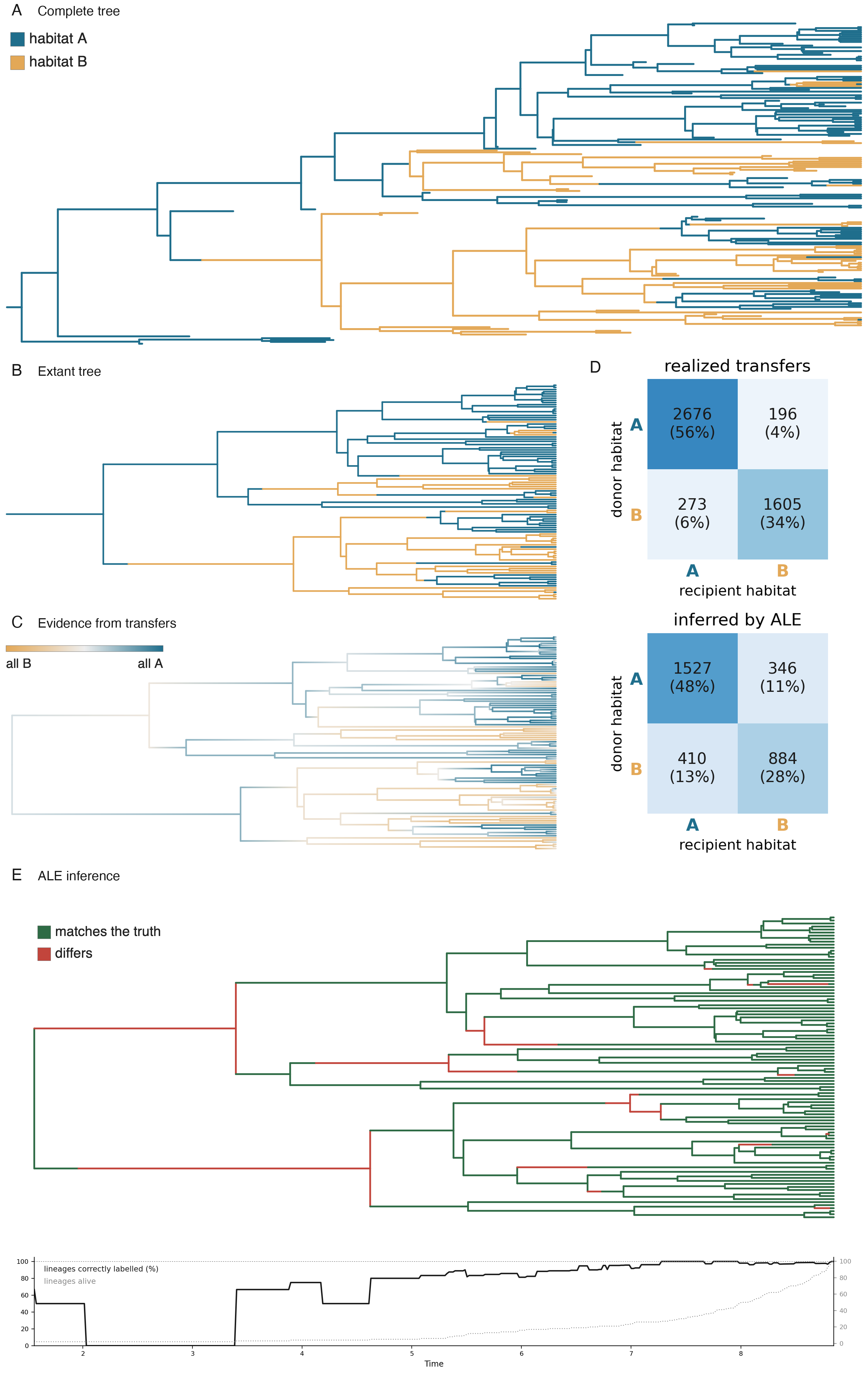
The limits
The errors concentrate where lineages are few: the share of contemporaneous lineages correctly labelled rises from 50% near the root to nearly 100% at the present, and the deepest branches are misclassified even on the error-free network. An undated reconciliation also cannot place a habitat switch inside a branch, so on the seven branches whose habitat switched within their span, part of the branch is mislabelled whichever habitat is assigned. And one practical lesson: letting classified branches vote in later rounds helps on the error-free network but hurts on the inferred one, because wrong calls then propagate. On inferred networks, the tip-anchored votes are the ones to trust.