A tour of ZOMBI2
This chapter introduces the four levels ZOMBI2 simulates, the three ways they can relate, and the single shape every rate takes.
The four levels of ZOMBI2
- Species — the tree of lineages: a strictly bifurcating rooted tree, with branches measured in time. Every workflow has a species tree, so this is the first thing to run.
- Genomes — the genes that exist in each lineage. Genomes can be simulated at three resolutions: gene families alone, genes placed on chromosomes, or a full nucleotide genome. A genome is always simulated within a species tree.
- Sequences — the nucleotides or amino acids inside each gene. Sequences evolve on gene trees, so genomes must be simulated first.
- Traits — phenotypes evolving along a tree: body size, optimal growth temperature, the presence or absence of a flagellum.
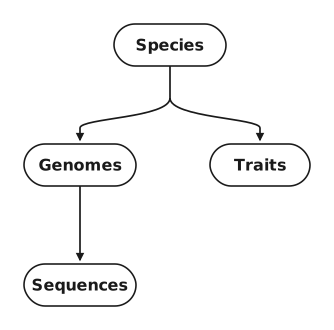
A run in which every level is simulated:
You need not run them all. Skip sequences if you only want gene trees, which the genome level already produces:
Skip genomes if you want a species tree with traits on it:
Everything depends on a species tree, so a workflow almost always begins by simulating one alone. The exception is a joint model, below, where the tree is an output rather than an input.
Time
ZOMBI2 is a forward simulator: evolution runs from an ancestral state at time 0 to the present.
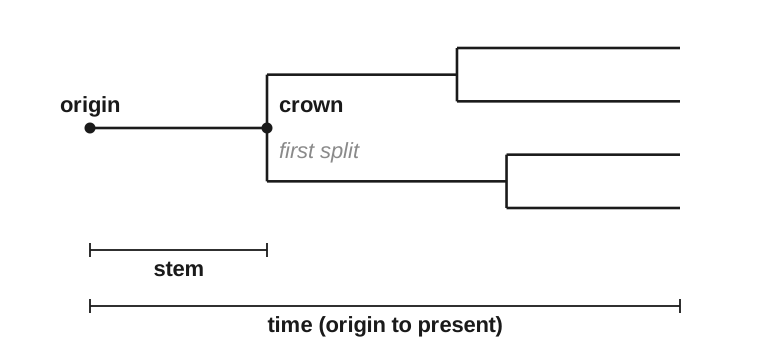
Time is imposed by the species tree, and every rate is measured against that scale. If your tree runs from 0 at the root to 1 at the tips, the simulation lasts one unit of time. Time 0 is the origin of the founding lineage, and every time you give ZOMBI2 — the moment of a mass extinction, the breakpoints of a rate that changes through time — is measured on it.
The founding lineage lives for a while before it first splits. That stretch is the tree's stem, and the first split is its crown.
Rates
Everything is driven by events that fire over time:
- Species — speciations and extinctions
- Genomes — duplications, transfers, losses, originations, inversions, transpositions
- Sequences — substitutions
- Traits — phenotypic changes
How often an event fires is its effective rate:
The base is the speed of a single event (how fast), in units of inverse time. The scope wraps it to say how many independent chances the event has: per lineage, per copy, per site. The modifiers are dimensionless multipliers that make a rate faster or slower depending on context — the lineage, the gene family, the total diversity present.
You rarely need to touch the default scope or the modifiers. With them you can simulate:
- an early burst that tapers off, by giving the rate a schedule that starts high and drops;
- a molecular clock that speeds and slows along the tree, with close relatives ticking alike, by letting each lineage inherit its rate from its parent and drift at every split;
- a radiation that eases off as the clade fills up, by having the speciation rate read the diversity present at each moment.
Appendix A is the full rate reference — the units, each level's default scope, the catalogue of modifiers — and the Gillespie algorithm that turns rates into events.
Going beyond: conditioning and joining levels
Some scenarios need more than the levels running in sequence:
- A trait evolves along a tree and controls how fast that tree speciates.
- Gene content decides survival: lineages that acquire a key gene diversify faster.
- Two levels feed back: a trait raises a gene family's loss rate, and carrying that family pulls on the trait.
ZOMBI2 adds two connections for these — conditioning and joining. Each has its own chapter; this is the shape of them.
Conditioning makes a parameter of one level read the state of another instead of being a fixed number. Aquatic lineages lose their olfactory genes faster: the gene-loss rate depends on the trait's value on each branch. Because the trait can be simulated first and then held fixed, this is still two ordinary runs in order — simulate the driver, write it out, feed it to the second, exactly as you already feed a species tree to a genome run.
Joining is for when neither level can go first. If a trait speeds up speciation, faster-speciating lineages leave more descendants, so the tree's shape depends on the trait — while the trait is evolving along that very tree. No order works, so both are grown together in one run, and the tree becomes an output rather than an input.
The test is whether the influence runs one way or in a loop. One way: condition. In a loop — one level shaping another and being shaped back, directly or through the tree — join.
Using ZOMBI2 in Python
Each level is a function in its own subpackage, and they compose by feeding one level's result into the next. A run returns a result object; read it in the session or write it to disk with .write(). A whole workflow is a short script:
from zombi2 import species, genomes, sequences, traits
from zombi2.sequences import substitution_models as sm

sp   = species.simulate_species_tree(birth=1.0, death=0.3, n_extant=20, seed=1)
gen  = genomes.simulate_genomes_family(sp, duplication=0.2, loss=0.25, origination=0.5, seed=42)
seqs = sequences.simulate_sequences(gen, model=sm.hky85(kappa=2.0), length=300, seed=7)
bm   = traits.simulate_continuous(sp, rate=1.0, seed=1)
Each call takes the object it depends on — genomes and traits read the species result, sequences reads the genomes result — so the script reads top to bottom in the P(·) order above.
Using ZOMBI2 from the CLI
The same simulations run from the command line. Each level is a subcommand of zombi2, and its flags are the long-form names of the Python arguments:
# a dated species tree (20 extant tips)
zombi2 species out/ --birth 1 --death 0.3 --n-extant 20 --seed 1

# gene families along it
zombi2 genomes out/ --duplication 0.2 --loss 0.25 --origination 0.5 --seed 42
A rate flag takes a rate written exactly as you would write it in Python — a bare number, or a scope wrapper and modifiers composed with *, quoted so the shell keeps it in one piece:
# speciation drops to a third of its rate at time 3 (a skyline)
zombi2 species out/ --birth "1.0 * OnTime({0: 1.0, 3: 0.3})" --death 0.3 --total-time 5 --seed 1
Every command takes one positional argument, the run directory. It is both where that command writes and where it reads the level before it, so a pipeline is the same directory named once per command and nothing is passed by hand. --from overrides the reading half, for a tree from elsewhere or a run you would rather not write into; a --params TOML file can hold a whole pipeline's settings.
Because the levels share one directory, a command refuses to re-run a level in place when a later level was built from it — that would leave the later output out of step. --force re-runs anyway and removes the now-stale downstream. The CLI covers all four levels; the coupled models are run from Python until their commands land.
Output in ZOMBI2
Every run can be written with result.write("out/", outputs=[...]); with no outputs it writes that level's default set. The formats are uniform — trees in Newick, tables and event logs in TSV, sequences in FASTA. Branch lengths are in time everywhere except the sequence phylograms, which are in substitutions per site.
At every level the event log (*_events.tsv) is the true, ordered history the run followed: the source of truth the summaries are derived from. Appendix B lists every file, level by level.